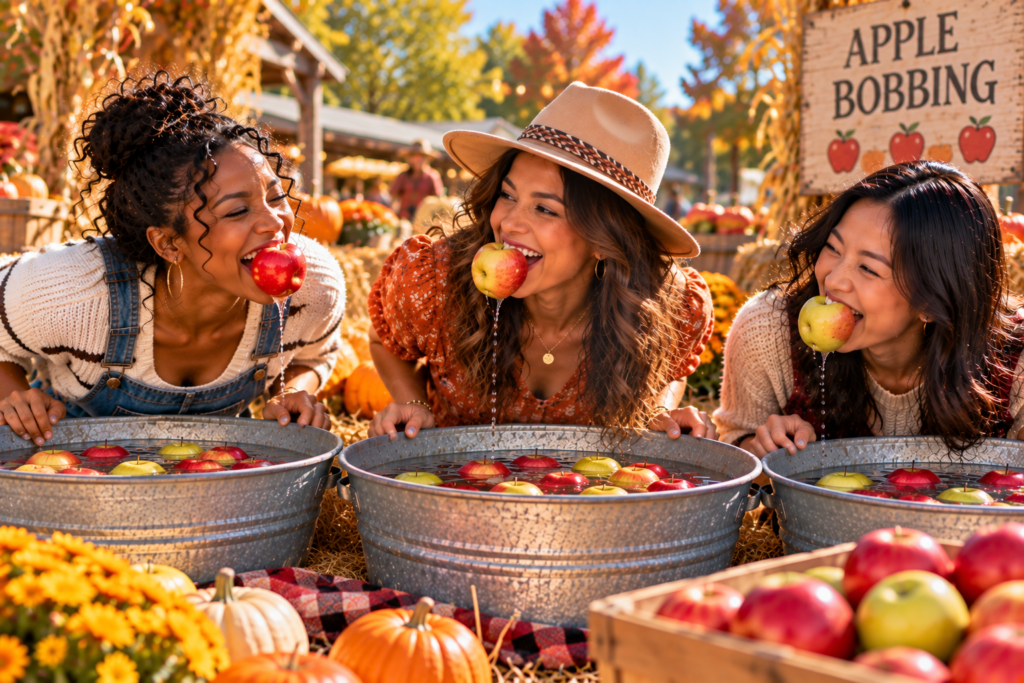
 Before it became a goofy Halloween party game, grabbing an apple with your teeth could supposedly tell you something much more important: who you were going to marry.
At some point, somebody looked at a perfectly good apple floating in a tub of water and decided the logical thing to do was put their hands behind their back, plunge their face into the water and attempt to grab it with their teeth. Even stranger, generations of people watched this happen and thought, Yes, let’s make this a Halloween tradition.
Bobbing for apples is one of those things we’ve been doing for so long that almost nobody stops to ask why. Pumpkins make sense in October. Apples make sense in autumn. But soaking your face in a communal bucket while chasing a Granny Smith? There has to be a story there.
There is. And it involves Halloween, harvest celebrations, fortune-telling and, perhaps most unexpectedly, romance.
Before Tinder, There Were Apples
Long before apple bobbing became children’s-party entertainment, versions of the game were associated with courtship. In Britain, floating apples could represent potential romantic partners, and successfully catching one was believed to reveal something about a young woman’s romantic future. One tradition held that catching the desired apple on the first attempt meant marriage was in the cards; two attempts suggested a courtship that wouldn’t last, while three unsuccessful tries were decidedly bad news for the relationship.
 Other versions were even more elaborate. The first person to catch an apple might supposedly be the first to marry. A young woman could put the apple she caught beneath her pillow and hope to dream about her future spouse. In another tradition, she peeled the apple, swung the peel over her head and tossed it behind her; whatever letter the peel resembled when it landed was supposedly the first initial of her future husband.
So How Did It Become Halloween?
This is where the history becomes a little murkier. A popular explanation connects apples with Pomona, the Roman goddess associated with fruit and orchards, whose traditions may have mingled with seasonal customs in Britain during centuries of Roman rule. Apples also became deeply embedded in the Halloween traditions surrounding Samhain in Ireland and Scotland. Historians don’t have a single neat document announcing the invention of Halloween apple bobbing, however, so the often-repeated Roman-to-Samhain origin story is better understood as one explanation for how apples became part of the season rather than a perfectly documented moment of invention.
What we do know is that apples and fortune-telling were very much part of later Irish Halloween celebrations. Before the Great Famine, Halloween gatherings in western Ireland included apples, nuts and games intended to predict marriage and other parts of a person’s future. Apple games were so closely connected to the holiday that Halloween was sometimes known as Snap-Apple Night.
 As Irish and Scottish immigrants brought Halloween customs to North America, apple games came with them. By the late 19th century, bobbing for apples had become fashionable entertainment at American Halloween parties. An 1894 Philadelphia newspaper described apple bobbing as one of the old Scottish games associated with Halloween, and artwork from the period depicts Halloween parties filled with courtship games and fortune-telling rituals.
Over time, the matchmaking element largely disappeared. Nobody cared whether the Honeycrisp predicted a handsome stranger anymore. Bobbing simply became one of those delightfully ridiculous Halloween activities children—and occasionally very competitive adults—were expected to attempt.
Did you know?
The traditional communal tub isn’t exactly ideal from a germ-sharing standpoint. The University of Missouri Extension suggests more hygienic variations, including hanging individual apples from strings so each participant gets their own fruit.
A little history:
There was also Snap Apple, in which an apple was suspended from a string and players tried to bite it without using their hands. Ireland still recognizes apple bobbing and Snap Apple among its traditional Halloween harvest games, along with other customs that once supposedly revealed clues about a person’s future.