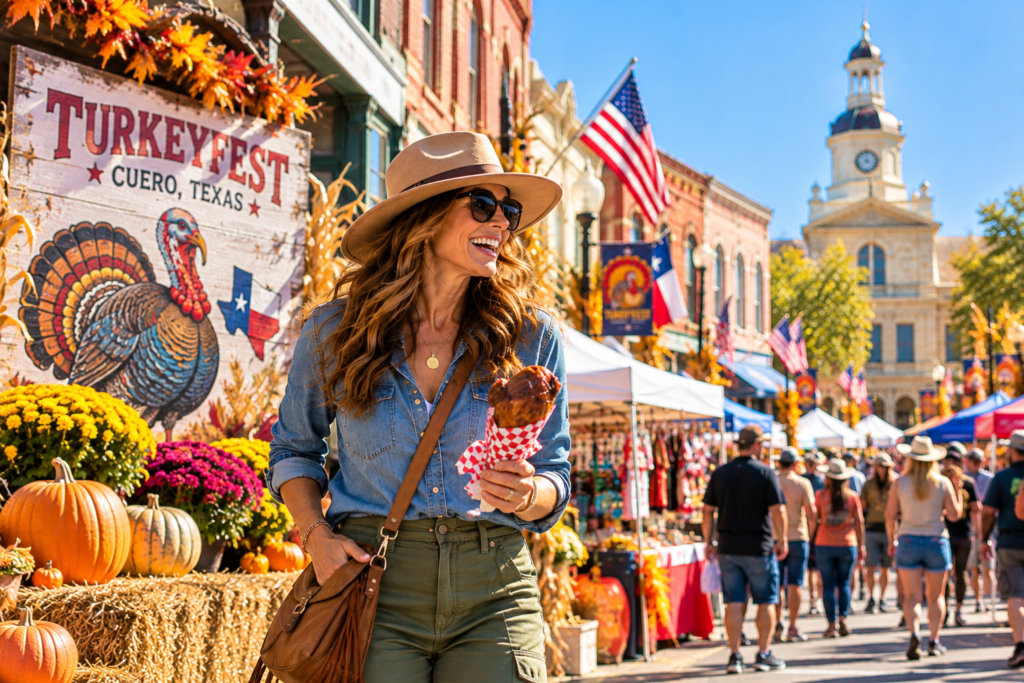
 Forget the Thanksgiving table. From racing turkeys to towns built on the bird business, these American destinations take their turkey traditions very seriously.
Every November, Americans collectively become obsessed with one bird. We roast it, fry it, brine it, debate whether it’s dry, argue over who gets the wishbone and spend the next several days figuring out increasingly creative things to do with the leftovers. But long before Thanksgiving arrives, there’s a little town in South Texas where turkey isn’t simply dinner. It’s practically a local celebrity.
Welcome to Cuero, Texas, a town with one of the quirkiest claims to fame in America: Turkey Capital of the World. And while plenty of places bestow impressive-sounding titles upon themselves, Cuero has more than a century of turkey history to back this one up.
Cuero’s turkey story began as business rather than spectacle. By the early 1900s, turkey raising had become an important part of the region’s agricultural economy, and in 1908, a turkey-processing plant opened near the railroad. There was just one logistical problem: farmers needed to get their birds from surrounding farms into town, and this was before trucks could simply pull up and load thousands of them.
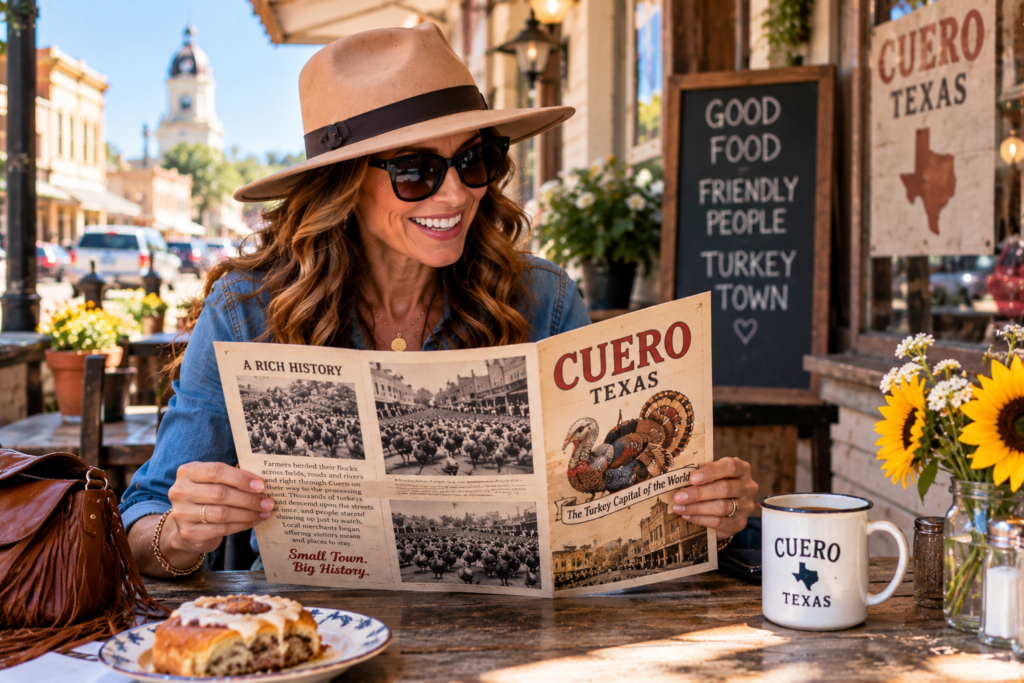 So they walked them.
Farmers herded their flocks across fields, roads and rivers and right through Cuero on their way to the processing plant. Imagine a cattle drive, only shorter, featherier and considerably less cooperative. Thousands of turkeys could descend upon the streets at once, and understandably, people started showing up just to watch. Local merchants noticed the crowds and began offering visitors meals and places to stay.
Eventually someone had the wonderfully American thought: We should turn this into a festival.
Cuero staged its first official Turkey Trot in November 1912, and according to the festival’s historical records, an estimated 30,000 people came to town to watch more than 18,000 turkeys make their way down Main Street. Corn was scattered along the route to encourage the somewhat reluctant parade participants to keep moving. There were floats, dances, agricultural exhibits, a football game and even a visit from Texas Governor Oscar Colquitt.
Turkey had officially gone from local industry to local identity.
There was just one problem with calling Cuero the Turkey Capital of the World: another American town thought the title belonged to them. More than 1,100 miles north, Worthington, Minnesota, had its own deep connection to the turkey industry and its own celebration, King Turkey Day, which dates to 1938. Eventually, representatives from the two communities came up with a gloriously ridiculous way to settle the matter.
They would race turkeys.
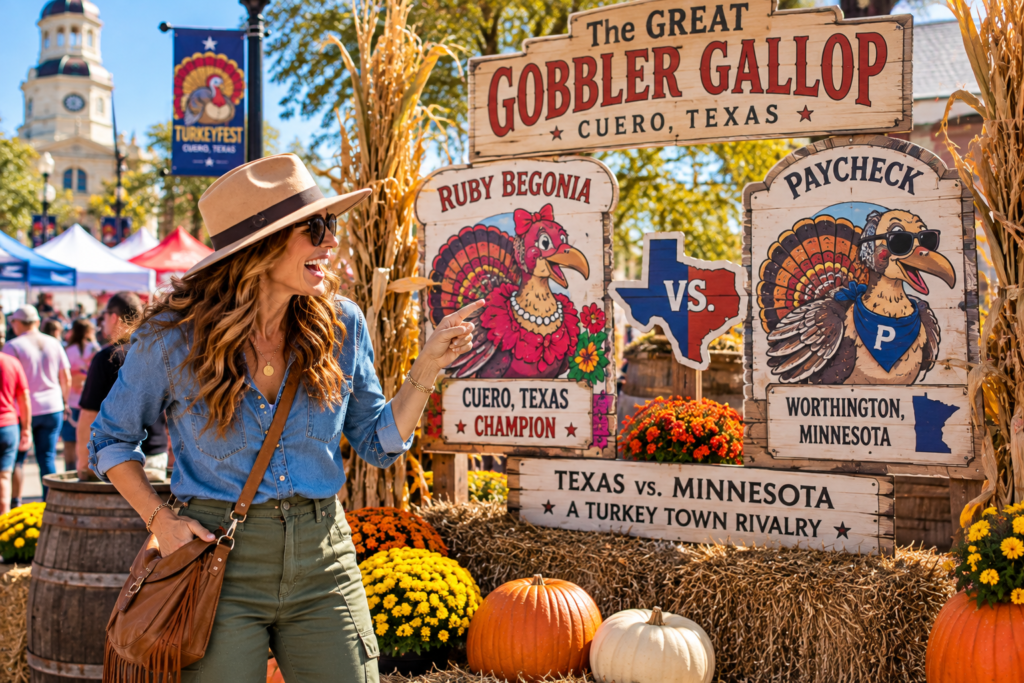 The competition became the Great Gobbler Gallop, a two-town rivalry featuring Cuero’s racing turkey, Ruby Begonia, against Worthington’s Paycheck. One leg of the competition is associated with Worthington’s celebration and the other with Cuero’s Turkeyfest, with combined race times determining bragging rights. Even the trophies refuse to take themselves seriously: the winner gets the Traveling Turkey Trophy of Tumultuous Triumph, while the loser receives the Circulating Consolation Cup of Consummate Commiseration.
The rivalry continues today, and Cuero still lists the Great Gobbler Gallop among the signature events of its annual Turkeyfest.
The enormous turkey drives are history, but Cuero never abandoned the bird that helped put it on the map. The original Turkey Trot eventually ended, and in 1973 the community created Turkeyfest as an annual celebration of its agricultural heritage.
Today, Turkeyfest mixes small-town Texas festival with just enough turkey-related absurdity to make the trip memorable. There’s the Great Gobbler Gallop, a downtown parade, carnival, live music, barbecue cook-off, kids’ activities and, because apparently there is a limit to how ironic a turkey festival can be, vendors really do sell turkey legs.
 The racing itself may be the best part. Wild turkeys can run surprisingly fast — Turkeyfest says as fast as 20 miles per hour — but that does not mean Ruby Begonia and Paycheck reliably head toward the finish line. That’s part of the attraction. When the birds hit the street, athletic strategy can apparently be replaced at any moment by a turkey deciding it has somewhere else to be.
Did you know?
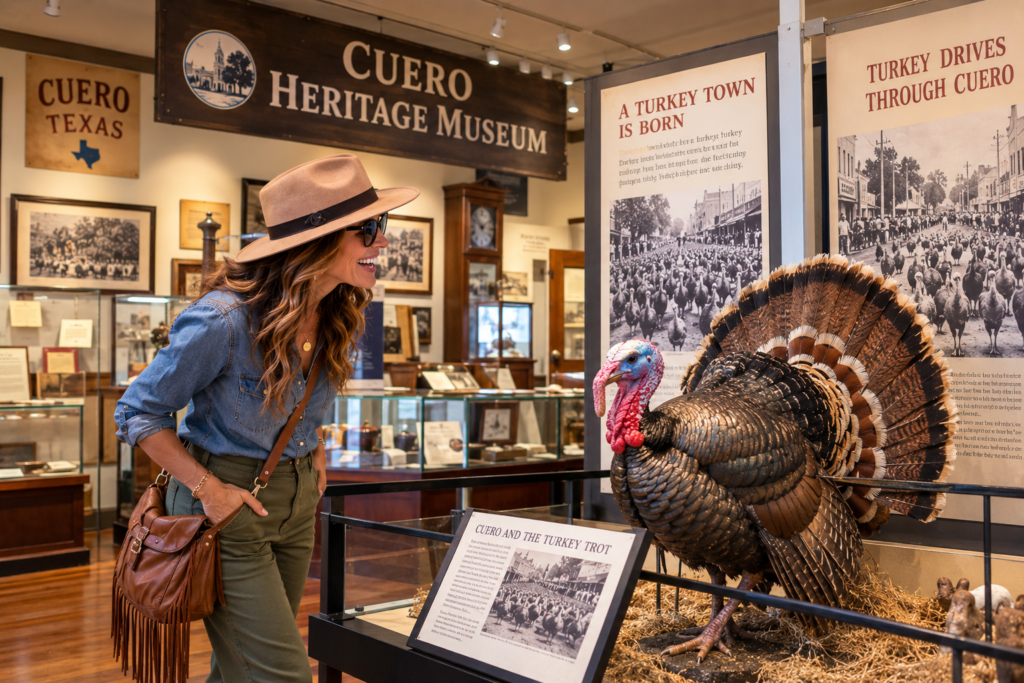
Cuero’s turkey connection isn’t confined to festival weekend, either. The city points visitors to the Cuero Heritage Museum to learn more about the community’s history, while downtown retains the feel of the small South Texas town that once watched thousands of birds parade through its streets.
A little History:
If the question is “Where is Thanksgiving most famously celebrated?”, Plymouth, Massachusetts, is difficult to beat. The 1621 harvest gathering shared by English colonists and Wampanoag people became intertwined with the story Americans now associate with Thanksgiving, although historians emphasize that the event and its meaning are considerably more complicated than the simplified version many of us learned in school.


